
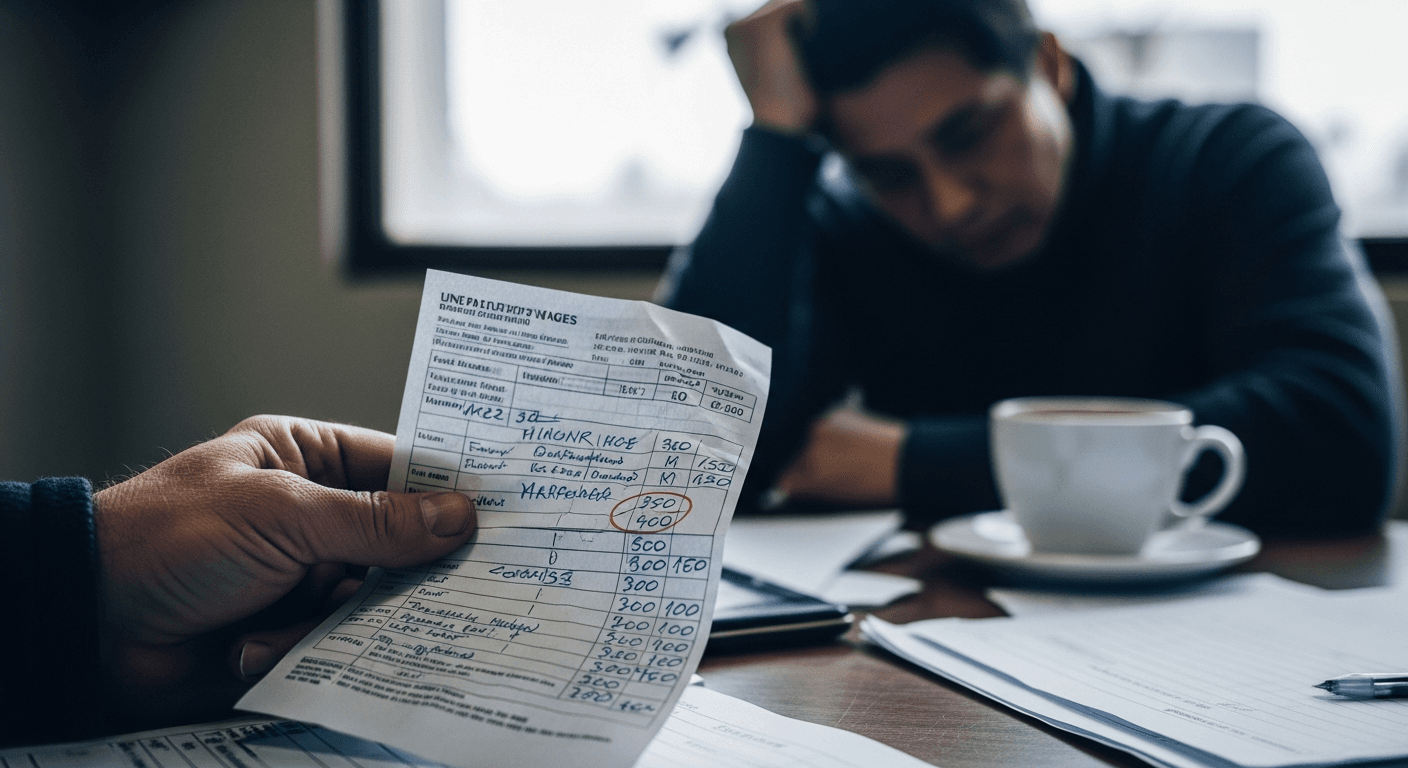
Unpaid Wages Attorneys
Experienced legal representation for unpaid wages matters across all 50 states.
About Unpaid Wages
Unpaid wages represent one of the most pervasive labor violations in the United States, affecting workers across virtually every industry and at every income level. An unpaid wages claim arises when an employer fails to compensate an employee for work performed, whether through outright nonpayment, underpayment, failure to pay overtime premiums, improper deductions, withholding final paychecks, or not paying for all compensable hours worked. These violations are governed by the federal Fair Labor Standards Act (FLSA) as well as state wage payment laws, which often provide additional protections and remedies beyond federal requirements.
The scope of unpaid wages cases is broad. They encompass situations where employers pay less than the applicable minimum wage, fail to compensate workers for pre-shift or post-shift activities, require employees to work through meal breaks without pay, shave time from employee timesheets, fail to include non-discretionary bonuses in overtime calculations, or withhold commissions and earned bonuses. Tipped employees are particularly vulnerable, as complex tip credit rules create opportunities for employers to shortchange workers, and many tipped workers are unaware of the minimum wages and tip protections that apply to them.
Pursuing an unpaid wages claim can involve filing an administrative complaint with the U.S. Department of Labor or a state labor agency, negotiating directly with the employer, or filing a lawsuit in state or federal court. The FLSA allows employees to recover not only the unpaid wages themselves but also an equal amount in liquidated damages, plus reasonable attorney's fees and costs. Many state laws provide even greater remedies, including treble damages and waiting time penalties. An attorney experienced in unpaid wages claims can help workers navigate these options and determine the most effective path to recovering the compensation they have earned.
Why You Need an Unpaid Wages Attorney
Unpaid wages have a direct and immediate impact on workers' ability to pay rent, buy food, cover medical expenses, and support their families. The Economic Policy Institute estimates that wage theft costs workers more than $50 billion per year, dwarfing losses from all property crimes combined. Low-wage workers are disproportionately affected, with studies showing that minimum wage violations alone cost affected workers an average of $3,300 per year — a devastating sum for workers already earning the least.
Despite the scale of the problem, many workers do not pursue their claims because they fear retaliation, do not know their rights, or believe the amounts involved are too small to justify legal action. However, when violations affect multiple employees, collective and class actions can recover substantial sums. An unpaid wages attorney helps level the playing field by holding employers accountable and ensuring that workers receive every dollar they have earned under the law.
Common Unpaid Wages Cases
Failure to Pay Minimum Wage
Employers paying hourly rates below the applicable federal, state, or local minimum wage, or making deductions that bring effective pay below the minimum wage floor.
Withheld Final Paychecks
Employers failing to pay departing employees their final wages, including accrued vacation and earned commissions, within the timeframe required by state law.
Unpaid Commissions and Bonuses
Employers refusing to pay earned commissions or non-discretionary bonuses after an employee meets the performance criteria specified in their compensation agreement.
Time Shaving
Employers altering or manipulating employee time records to reduce the number of hours recorded, resulting in workers not being paid for all time actually worked.
Unpaid Training Time
Requiring employees to attend training sessions, orientations, or meetings without compensation, even though such time is generally compensable under the FLSA.
Improper Payroll Deductions
Deducting costs for uniforms, tools, equipment breakage, or cash register shortages from employee paychecks in ways that violate state wage deduction laws or reduce pay below minimum wage.
Typical Unpaid Wages Case Timeline
Evidence Gathering and Analysis
1–3 weeksThe attorney collects and reviews pay stubs, time records, employment agreements, and any written policies to calculate the total amount of unpaid wages owed.
Demand Letter or Agency Complaint
1–3 monthsA formal demand is sent to the employer, or a complaint is filed with the Department of Labor or state labor agency. Many cases resolve at this stage when employers prefer to pay rather than face investigation.
Filing Lawsuit
1–2 monthsIf the employer refuses to pay, a lawsuit is filed in state or federal court. The complaint details the violations and seeks unpaid wages, liquidated damages, penalties, and attorney's fees.
Discovery
4–12 monthsBoth sides exchange payroll records, timekeeping data, and relevant communications. Depositions of managers and payroll personnel may be taken to establish the employer's pay practices.
Settlement or Mediation
1–3 monthsThe parties attempt to negotiate a resolution, often with the assistance of a mediator. The vast majority of unpaid wages cases settle before reaching trial.
Trial
2–7 daysIf settlement fails, the case proceeds to trial where the judge or jury determines the amount of unpaid wages owed and whether liquidated damages and penalties apply.
Know Your Rights
- You are entitled to be paid at least the applicable minimum wage for every hour worked, including the highest applicable rate among federal, state, and local minimums.
- Your employer must pay you for all compensable time, including required training, pre-shift and post-shift duties, and time you are required to remain on the employer's premises.
- Most states require employers to pay final wages within a specified number of days after termination — often immediately for involuntary terminations and by the next regular payday for voluntary resignations.
- Your employer cannot make deductions from your pay that reduce your wages below the minimum wage, and many states prohibit deductions for uniforms, tools, and business expenses entirely.
- You have the right to file a wage complaint with the Department of Labor or a state labor agency without retaliation. It is illegal for your employer to punish you for asserting your wage rights.
- Under the FLSA, you can recover liquidated damages equal to your unpaid wages, effectively doubling your recovery, plus attorney's fees and costs.
What to Look for in an Unpaid Wages Attorney
When seeking an attorney for unpaid wages, look for a lawyer with demonstrated experience in wage payment claims under both federal and state law. State wage laws often provide significantly stronger remedies than the FLSA, including treble damages and per-day penalties, so your attorney should be well-versed in the specific laws of your state. Ask how many unpaid wages cases the attorney has handled and whether they have experience with your particular type of claim — whether it involves withheld commissions, minimum wage violations, time shaving, or final paycheck disputes. Inquire about the attorney's ability to handle your case as part of a larger collective or class action if multiple workers at your employer are affected. Many unpaid wages attorneys work on contingency and the FLSA provides for fee-shifting to prevailing plaintiffs, so confirm the fee arrangement and whether you will owe anything if the case is unsuccessful. A good attorney should also be able to advise you on preserving evidence such as pay stubs, time records, and written communications.
Questions to Ask Your Unpaid Wages Attorney
- 1What is the total amount of unpaid wages I am owed, and how did you calculate that figure?
- 2Should I file a complaint with a government agency, or is a private lawsuit a better option for my case?
- 3Does my state's wage payment law provide stronger remedies than the FLSA, such as treble damages or waiting time penalties?
- 4Are other workers at my employer affected by the same pay practices, and would a collective or class action be appropriate?
- 5What is the statute of limitations for my unpaid wages claim, and have I already lost any time?
- 6Will I owe any attorney's fees if we do not prevail?
- 7What evidence do I need to preserve, and what should I do if my employer has not provided accurate pay records?
Understanding Unpaid Wages Legal Costs
Unpaid wages attorneys on the plaintiff side typically work on a contingency fee basis, charging 33% to 40% of the recovery. Under the FLSA, courts award reasonable attorney's fees to prevailing employees in addition to unpaid wages and liquidated damages, which means the fee award often comes from the employer rather than reducing the employee's recovery. State wage payment laws frequently include similar fee-shifting provisions. For smaller claims, filing a complaint with the state labor agency or the U.S. Department of Labor is often free and does not require an attorney. Some attorneys offer flat-fee arrangements for demand letters or limited-scope representation. Initial consultations are usually free, allowing you to get a preliminary assessment of your claim without financial risk.
Key Legal Terms
Video Resources
These videos are provided for informational purposes only. The attorneys and organizations featured are not affiliated with or endorsed by Northwind Law.
Wage Theft in America: How Employers Steal Billions
Vox
What is Wage Theft? | Robert Reich
Robert Reich
How to File a Wage Claim
LawShelf
Frequently Asked Questions About Unpaid Wages
Citations & Sources
- [1]Wage theft costs U.S. workers an estimated $50 billion per year, exceeding losses from all property crimes combined. — Economic Policy Institute
- [2]In FY 2023, the Wage and Hour Division found violations in 69% of its investigations, recovering $274 million for over 163,000 workers. — U.S. Department of Labor, Wage and Hour Division
- [3]An estimated 17% of low-wage workers experience minimum wage violations, costing affected workers an average of $3,300 per year. — Economic Policy Institute
- [4]The FLSA requires employers to pay liquidated damages equal to the amount of unpaid wages unless they can prove the violation was in good faith. — 29 U.S.C. § 216(b)
Ready to Discuss Your Unpaid Wages Case?
Speak with an experienced unpaid wages attorney. Free consultations available.