
Court Martial Attorneys
Experienced legal representation for court martial matters across all 50 states.
About Court Martial
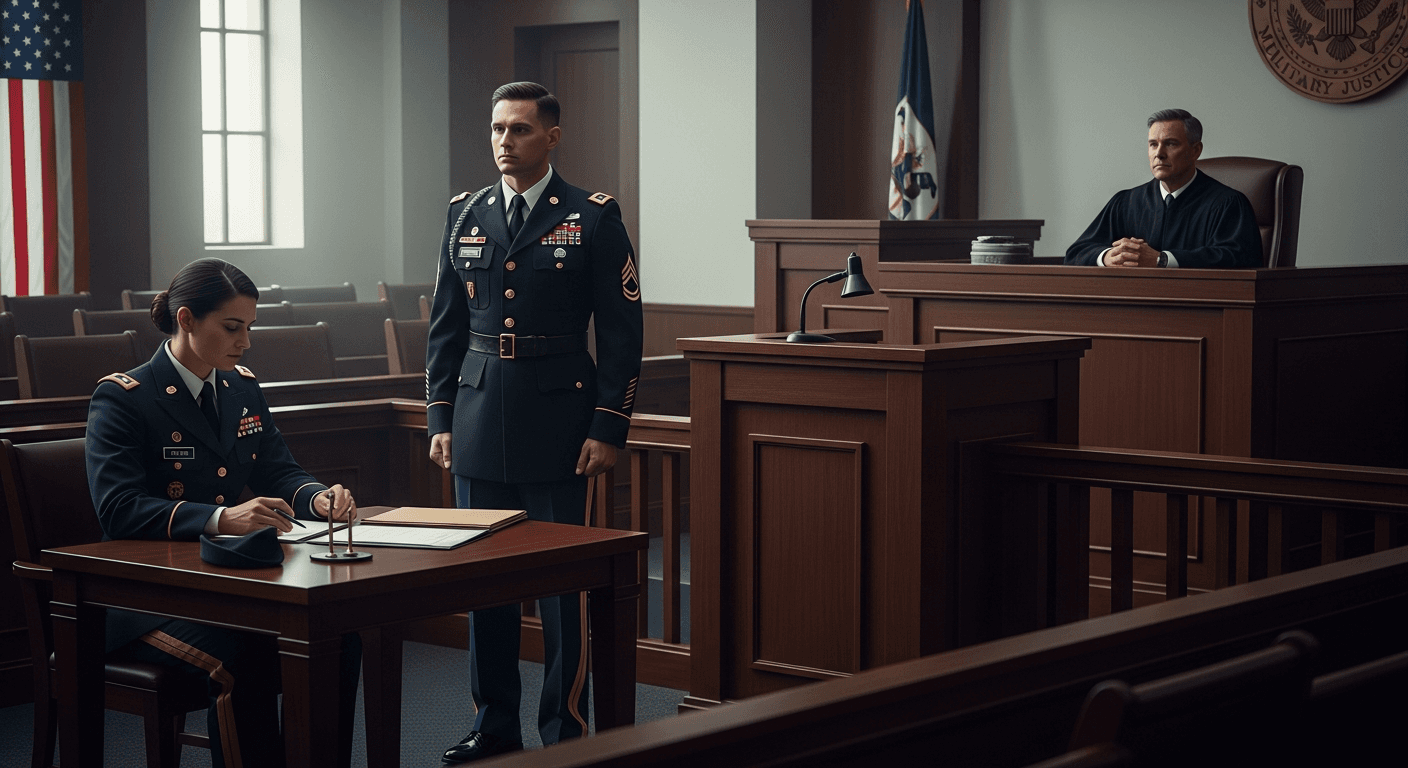
A court-martial is a military court convened under the Uniform Code of Military Justice (UCMJ) to try members of the armed forces for offenses defined in the UCMJ, which encompasses both crimes that have civilian equivalents such as assault, theft, and drug offenses, and uniquely military offenses such as desertion, insubordination, conduct unbecoming an officer, and failure to obey a lawful order. The UCMJ, codified at 10 U.S.C. §§ 801-946a, establishes the substantive criminal law, procedural rules, and appellate structure for the military justice system. There are three types of courts-martial: summary, special, and general, each with different jurisdictional authority, procedural requirements, and maximum punishments.
A summary court-martial is the simplest form, presided over by a single commissioned officer, and can try only enlisted personnel for relatively minor offenses. The maximum punishment is limited to 30 days confinement, reduction in grade, and forfeiture of two-thirds pay for one month. A special court-martial is an intermediate-level court that can try any service member for most UCMJ offenses. It consists of a military judge and at least four panel members (the military equivalent of jurors), and can impose up to one year of confinement, a bad-conduct discharge, and forfeiture of pay. A general court-martial is the most serious level, convened by a general or flag officer, and can impose any punishment authorized by the UCMJ including death for certain offenses, dishonorable discharge, life imprisonment, and total forfeiture of pay and allowances.
The court-martial process involves several distinct stages: preferral of charges, investigation under Article 32 of the UCMJ (analogous to a grand jury proceeding), referral of charges to court-martial by the convening authority, arraignment, motions practice, trial, sentencing, and appeal. Service members facing court-martial have the right to be represented by a military defense counsel at no cost, and may also retain civilian defense counsel at their own expense.
Why You Need a Court Martial Attorney
A court-martial conviction can destroy a military career and follow a service member for the rest of their life. The consequences extend far beyond any period of confinement. A punitive discharge, whether dishonorable, bad-conduct, or dismissal for officers, permanently affects veteran status, eligibility for VA benefits including healthcare, education benefits under the GI Bill, home loan guaranty, and disability compensation. A dishonorable discharge carries a social stigma comparable to a felony conviction and must be disclosed on employment applications. Court-martial convictions are federal convictions that appear on criminal background checks and can affect the right to own firearms under federal law. For officers, a dismissal is the equivalent of a dishonorable discharge and effectively ends any possibility of post-military professional career paths that require a clean criminal record. The military justice system, while providing important procedural protections, operates under a command structure that can create unique pressures on the process.
Common Court Martial Cases
Drug Offenses
Violations of Article 112a, UCMJ, including use, possession, distribution, and manufacture of controlled substances. Drug offenses are among the most commonly prosecuted at courts-martial and typically result in separation from service.
Sexual Assault (Article 120)
Sexual assault, rape, and other sex offenses under Article 120, UCMJ. Following Congressional reforms, these cases are now referred by Special Trial Counsel independent of the chain of command. Penalties include lengthy confinement and sex offender registration.
AWOL and Desertion
Unauthorized absence from duty (Article 86) and desertion (Article 85). Penalties range from forfeiture of pay for short absences to years of confinement and dishonorable discharge for desertion during wartime.
Assault and Violent Crimes
Assault, aggravated assault, and assault with a dangerous weapon under Article 128. Military assault cases may involve unique considerations including the rank relationship between parties, location on military installations, and the impact on unit readiness.
Fraud and Financial Crimes
BAH fraud, travel voucher fraud, government credit card misuse, larceny of government property, and other financial crimes. These cases often involve both UCMJ charges and potential civilian federal prosecution.
Conduct Unbecoming an Officer (Article 133)
A uniquely military offense that applies only to commissioned officers and encompasses conduct that dishonors or disgraces the officer, including conduct that would be legal for a civilian but is unacceptable for an officer.
Insubordination and Disobedience
Failure to obey lawful orders (Article 92), disrespect toward a superior commissioned officer (Article 89), and mutiny or sedition (Article 94). These offenses reflect the unique disciplinary requirements of military service.
Typical Court Martial Case Timeline
Investigation and Preferral of Charges
1-6 monthsInvestigation by military criminal investigators (CID, NCIS, OSI, or CGIS), command inquiry, and the preferral of charges through the swearing of charge sheets by the accuser.
Article 32 Preliminary Hearing
2-4 weeks after preferralFor general courts-martial, an Article 32 preliminary hearing is conducted by a hearing officer to determine whether there is probable cause and whether the charges should be referred. The defense can cross-examine witnesses and present evidence.
Referral to Court-Martial
2-8 weeks after Article 32The convening authority reviews the preliminary hearing report and decides whether to refer the charges to a general or special court-martial. For certain offenses, Special Trial Counsel now make this decision.
Pretrial Motions and Discovery
1-4 monthsDefense counsel reviews the evidence, files pretrial motions including suppression motions, challenges to the panel, and requests for expert witnesses. Government provides discovery under the broader military disclosure obligations.
Trial
2 days to several weeksThe trial is conducted before a military judge alone or a panel of members (jury). If convicted, the sentencing phase follows, often immediately, with both sides presenting evidence in aggravation and mitigation.
Post-Trial and Appeal
6-24 monthsAutomatic review by the convening authority, followed by appellate review by the service Court of Criminal Appeals and potentially the U.S. Court of Appeals for the Armed Forces and the Supreme Court.
Know Your Rights
- You have the right to remain silent under Article 31 of the UCMJ, which is broader than the civilian Miranda right and applies whenever questioned by anyone acting in an official capacity about suspected offenses.
- You have the right to a detailed military defense counsel (JAG attorney) at no cost, and you may also hire a civilian attorney at your own expense. You may have both military and civilian counsel simultaneously.
- You have the right to request trial by military judge alone or by a panel of members, and the choice of forum is a critical strategic decision that should be made with the advice of counsel.
- You have the right to challenge panel members for cause and to exercise a peremptory challenge, similar to jury selection in civilian court.
- If convicted at a general or special court-martial, you have an automatic right to appellate review by the service Court of Criminal Appeals, which reviews both the law and the facts of your case.
- You have the right to request deferral and waiver of automatic forfeitures to provide for dependents while your case is on appeal.
- You have the right to submit clemency matters to the convening authority after trial and to request relief from the service Board for Correction of Military Records.
What to Look for in a Court Martial Attorney
When facing a court-martial, look for an attorney with specific experience in military justice, ideally including service as a military judge advocate (JAG) or extensive civilian practice before military courts. Every service member facing a special or general court-martial is entitled to a detailed military defense counsel (a JAG attorney) at no cost, but many also choose to retain experienced civilian defense counsel. A civilian attorney can bring additional resources, independence from the military command structure, and often more specialized experience. Look for an attorney who has tried cases before courts-martial in the specific branch of service involved, as each service has slightly different practices. Experience with the type of charge is important, as sexual assault defense, drug cases, and financial fraud each require different expertise. Ask about their familiarity with military rules of evidence, the Manual for Courts-Martial, and the appellate courts.
Questions to Ask Your Court Martial Attorney
- 1What are the specific charges under the UCMJ, and what are the maximum authorized punishments including confinement, discharge, and forfeiture of pay?
- 2Should I elect trial by judge alone or by panel (jury), and what are the strategic considerations for each option?
- 3What pretrial agreements (plea bargains) are possible, and what are the advantages and risks of accepting a pretrial agreement versus going to trial?
- 4How will a conviction affect my military career, retirement eligibility, VA benefits, and civilian employment prospects?
- 5What expert witnesses, investigators, or forensic experts should we request at government expense to prepare the defense?
- 6What motions should be filed to challenge the evidence, including suppression of statements, search and seizure issues, and speedy trial violations?
- 7What is the appellate outlook if the case goes to trial and results in a conviction?
Understanding Court Martial Legal Costs
Every service member facing a special or general court-martial is entitled to a free military defense counsel (JAG attorney). Many service members also retain civilian defense attorneys, whose fees typically range from $25,000 to $100,000 or more for a general court-martial, depending on the complexity of the case and the experience of the attorney. Complex cases involving sexual assault, homicide, or fraud can cost $100,000 to $250,000 or more. Some military defense attorneys offer flat fees for specific services such as Article 32 hearings or trial representation. The investment should be measured against the lifelong consequences of a conviction, including loss of military retirement, VA benefits, and the permanent stigma of a punitive discharge. Expert witnesses, investigators, and forensic consultants add to the cost.
Key Legal Terms
Video Resources
These videos are provided for informational purposes only. The attorneys and organizations featured are not affiliated with or endorsed by Northwind Law.
How Military Courts Work: The Court-Martial Process
Military Times
Your Rights Under the UCMJ
U.S. Army JAG Corps
Understanding the Military Justice System
American Bar Association
Frequently Asked Questions About Court Martial
Citations & Sources
- [1]The Uniform Code of Military Justice, enacted in 1950 and codified at 10 U.S.C. §§ 801-946a, provides the statutory framework for the military criminal justice system applicable to all members of the armed forces. — 10 U.S.C. §§ 801-946a
- [2]The Military Justice Improvement and Increasing Prevention Act of 2021 created Special Trial Counsel to handle prosecution decisions for serious offenses independent of the military chain of command. — National Defense Authorization Act for Fiscal Year 2022
- [3]Approximately 1,500 to 2,000 courts-martial are conducted annually across all branches of the armed forces, with conviction rates at general courts-martial averaging 85-90%. — Annual Reports, U.S. Court of Appeals for the Armed Forces
- [4]A dishonorable discharge results in the loss of virtually all veterans benefits, including VA healthcare, GI Bill education benefits, VA home loan guaranty, and burial in a national cemetery. — Department of Veterans Affairs, Benefits Overview
Ready to Discuss Your Court Martial Case?
Speak with a experienced court martial attorney. Free consultations available.